

From Furlough to Layoff: What a 2025 Shutdown Could Mean for Contractors
When shutdowns shift from temporary disruption to permanent reset, contractors must rethink how they operate.

Markets struggled today as Washington slouched toward a shutdown; the dollar slipped due to investor anxieties, and the policy fog grows thicker by the day. For contractors, the reality is sharper still: some agencies will keep moving while others will grind to a halt.
Reuters reports that the greenback dipped as traders priced in the chance that Congress will miss its funding deadline. Key economic data, including nonfarm payrolls and ISM reports, could be delayed if government statisticians are sent home.
Meanwhile, watchdogs warn that nearly $8 billion in already-approved funds are being withheld by the administration. Programs for health, education, and addiction treatment may never see those dollars hit the ground, a move critics call a “backdoor cut.”
For those of us who have been in GovCon a while, navigating this terrain from time to time is one of the costs of doing business. But the risks aren’t evenly spread; planning requires clarity on where the shock waves will land first.
What Makes This Different
Past shutdowns meant furloughs. They are temporary, and frustrating, but they are reversible. This one carries a sharper edge. An Office of Management and Budget memo directed agencies to treat the shutdown as an “opportunity” for permanent workforce reductions. Employees whose work isn’t funded or doesn’t align with administration priorities face layoffs, not just unpaid leave.
This shifts the calculus for contractors. This time we can’t just about ride out disruption. We’ve got to navigate an ecosystem that may emerge fundamentally smaller and restructured.
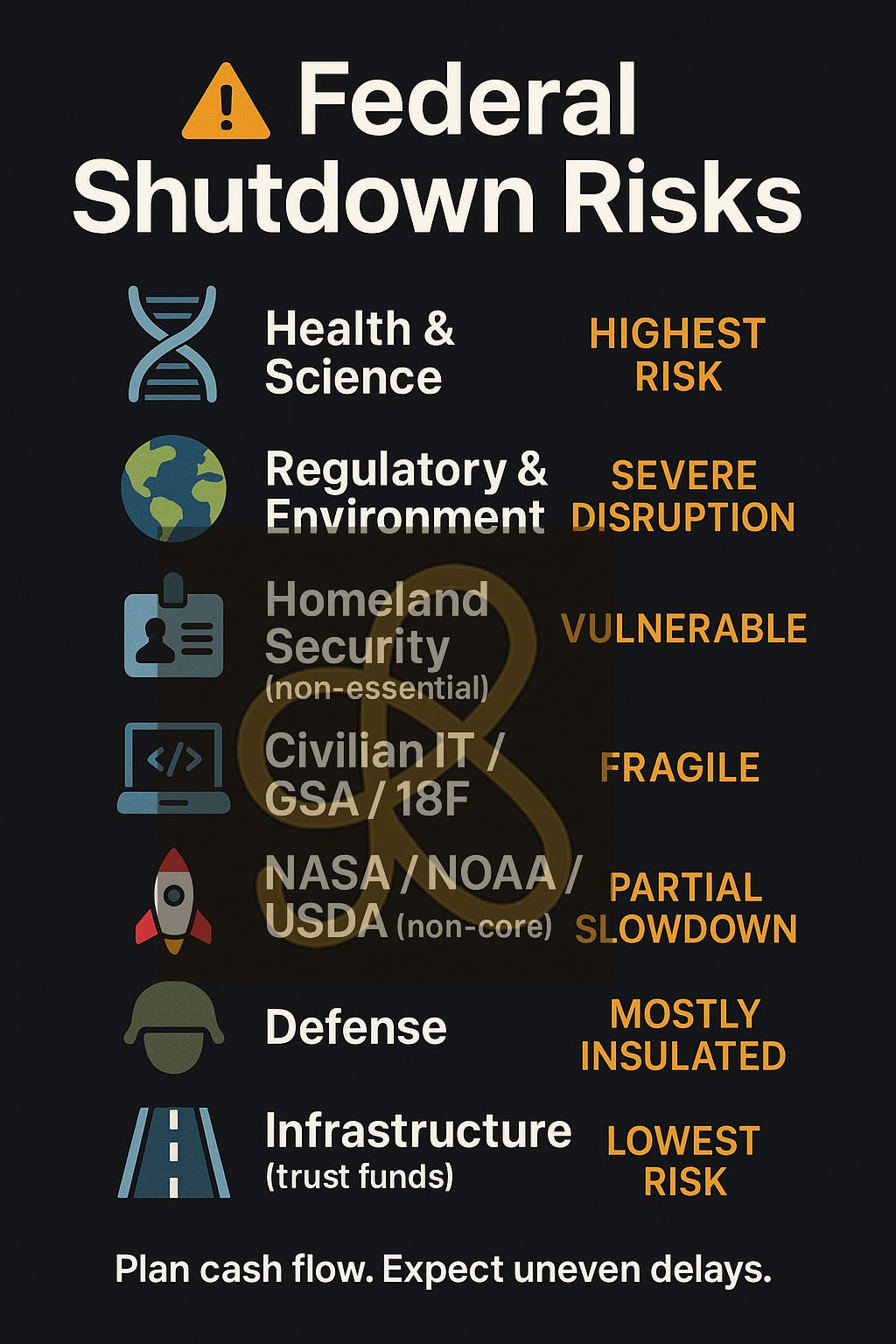
High-Risk Zones
1. Health and Science Agencies
The National Institutes of Health, Centers for Disease Control, and National Science Foundation sit squarely in the blast zone. These organizations depend on staff to review grants, oversee labs, and process research awards. When appropriations lapse, that work freezes. Reuters estimates that 41 percent of HHS employees could be furloughed, with CDC facing 64 percent and NIH over 75 percent. These changes will undoubtedly disrupt grant reviews, lab oversight, and research timelines across the board
2. Regulatory and Environmental Agencies
EPA inspectors, FDA reviewers, DOE regulators. All play critical roles in approvals, audits, and compliance checks. A shutdown halts much of that activity. We saw this play out during the 2013 shutdown, when regulatory backlogs cascaded across industries.
3. Homeland Security and Immigration Functions
Border security and frontline law enforcement continue under “essential” designations. But IT, adjudications, and consulting contracts are vulnerable. Federal News Network has already noted DHS contractors are pivoting hard to find opportunity amid budget instability.
4. Civilian IT and Digital Services
Agencies like GSA, 18F, and OMB carry the banner for digital modernization. Yet modernization depends on approvals, design reviews, and cyber checks that furloughed staff cannot deliver. 18F has already absorbed cuts and layoffs this year, leaving programs more fragile than ever.
5. Other Civilian Programs
NASA, NOAA, USDA: Essential missions such as satellite operations or food inspections will continue. But research, outreach, and cooperative agreements will be paused, delayed, or underfunded.
Lower-Risk but Not Immune
6. Defense and National Security
The Pay Our Military Act keeps most defense personnel working during shutdowns, but doesn’t guarantee timely paychecks. A new Pay Our Troops Act has been introduced to close that gap, but hasn’t passed. Even essential personnel could face delayed pay unless Congress acts before October 1.
7. Infrastructure and Transportation
Highways and transit programs funded through trust accounts or advance appropriations will continue. Yet projects needing environmental approvals or interagency coordination may still face delays. The Associated General Contractors note that cross-agency dependencies create soft spots, even in “protected” programs.
The Institutional Reset: What Permanent Cuts Mean for Contractors
Permanent workforce reductions create consequences that outlast the shutdown itself. When agencies lose experienced personnel, the operating environment doesn’t just pause. It changes shape.
Knowledge walks out the door. Agency staff who understand contract vehicles, technical requirements, and mission priorities represent years of accumulated expertise. Their departure means longer ramp-up times for replacements learning existing contracts. Requirement drift becomes more likely. Contractors will need more formal documentation to compensate for the informal knowledge transfer that used to happen in hallway conversations.
Relationships reset overnight. Contractors invest years building trust with contracting officers and program managers. Mass layoffs erase that capital in a single round of pink slips. New points of contact arrive unfamiliar with contract history. Replacement staff validate existing arrangements with fresh scrutiny.
Compliance becomes unpredictable. Fewer inspectors and auditors can make enforcement erratic, in addition to reducing compliance risk. Backlogs create compressed review cycles with higher rejection rates. Inexperienced staff apply regulations inconsistently. Retroactive compliance actions surface when oversight eventually catches up.
But disruption creates openings. A smaller federal workforce managing the same mission scope shifts more functions to contractors. Agencies will need expertise they no longer employ in-house. Firms offering stable institutional memory can command premium rates.
The talent market shifts too. Experienced federal employees enter the private sector, bringing specialized expertise into contractor ranks. Some contractors will face bidding wars for personnel with critical agency-specific knowledge. Others will find opportunity in the influx.
Operational Adjustments for Contractors
Document everything: your primary agency contact may not be there next quarter.
Diversify points of contact across multiple offices and levels.
Codify processes that currently rely on specific individuals.
Monitor which agencies are backfilling positions versus leaving them vacant.
Position for transition services, because agencies losing personnel will need help maintaining continuity.
The risk map is uneven. For some firms, invoices will keep moving and projects will continue. For others, awards will be delayed, invoices will stack up, and staff may face idle time (or worse). Shutdowns don’t shut down everything, but they scatter priorities and scramble decision-making.
Contractors should have cash flow models, contingency staffing plans, and proactive outreach to contracting officers already underway. Preparation matters. Those who prepare will navigate the turbulence. Those who don’t may find themselves stalled when October arrives.